AI & the Independent Operator
A Finished-Looking Website Isn't a Finished Website
AI has made prototyping faster than ever. That’s changed production, not the judgement a launch still needs.
 Colin HarrisonFounder18 September 2026
Quick answer
AI speeds up website concepts, layouts and prototypes. It doesn't understand a business's customers, priorities or booking journey. A polished-looking site can still fail on UX, accessibility, mobile performance or integrations — human judgement still decides strategy, hierarchy, conversion and QA.
AI Has Changed How Fast a Website Can Look Finished
AI is continuously evolving. Its advancements have made AI website tools more accessible than ever, but they can't take away the human element that's still needed.
AI website tools can now produce a working-looking design, layout or prototype in a fraction of the time it used to take — sites that used to take months can now launch in days. But we've found it still can't give you a finished, ready-to-publish site on its own.
At Booked Wild, we use AI in our own process to help us produce more websites, but our human touch is still needed. Speed alone isn't the whole story, though — it still takes someone technical behind the scenes to troubleshoot errors and make the calls AI can't.
Speed Lets You Test Ideas Earlier, Not Skip Testing
That speed has a real benefit: Nielsen Norman Group found that faster prototypes mean customer journeys can be tested sooner, while there's still time to change course.
For a booking website, that means the enquiry form, the availability calendar or the checkout flow can be tested against real users before a single line of production code is written.
The same applies across sectors: an itinerary builder for a tour operator, a multi-night availability search for a lodge, or a reservation flow for a destination restaurant can all be tested with real guests before launch, not after.
That doesn't mean testing gets skipped — it means more of it happens before launch instead of after, so fewer issues surface once the site is live. Speed is only useful if that time gets reinvested in testing, not skipped.
What AI Doesn't Know About Your Business
AI might be good for some things, but it doesn't automatically understand who a business's customers are, what they're trying to do on a website, or where they drop off in the booking journey. It can produce a plausible-looking layout without knowing which pages actually drive bookings.
For independent travel and hospitality operators, that gap matters more than most sectors. A generic AI build treats every sector the same when each is different. That's why having a human like us behind the build helps turn browsers into bookers.
We serve a range of sectors within travel and hospitality — see our who we serve page for more details.
Polished Isn't the Same as Working
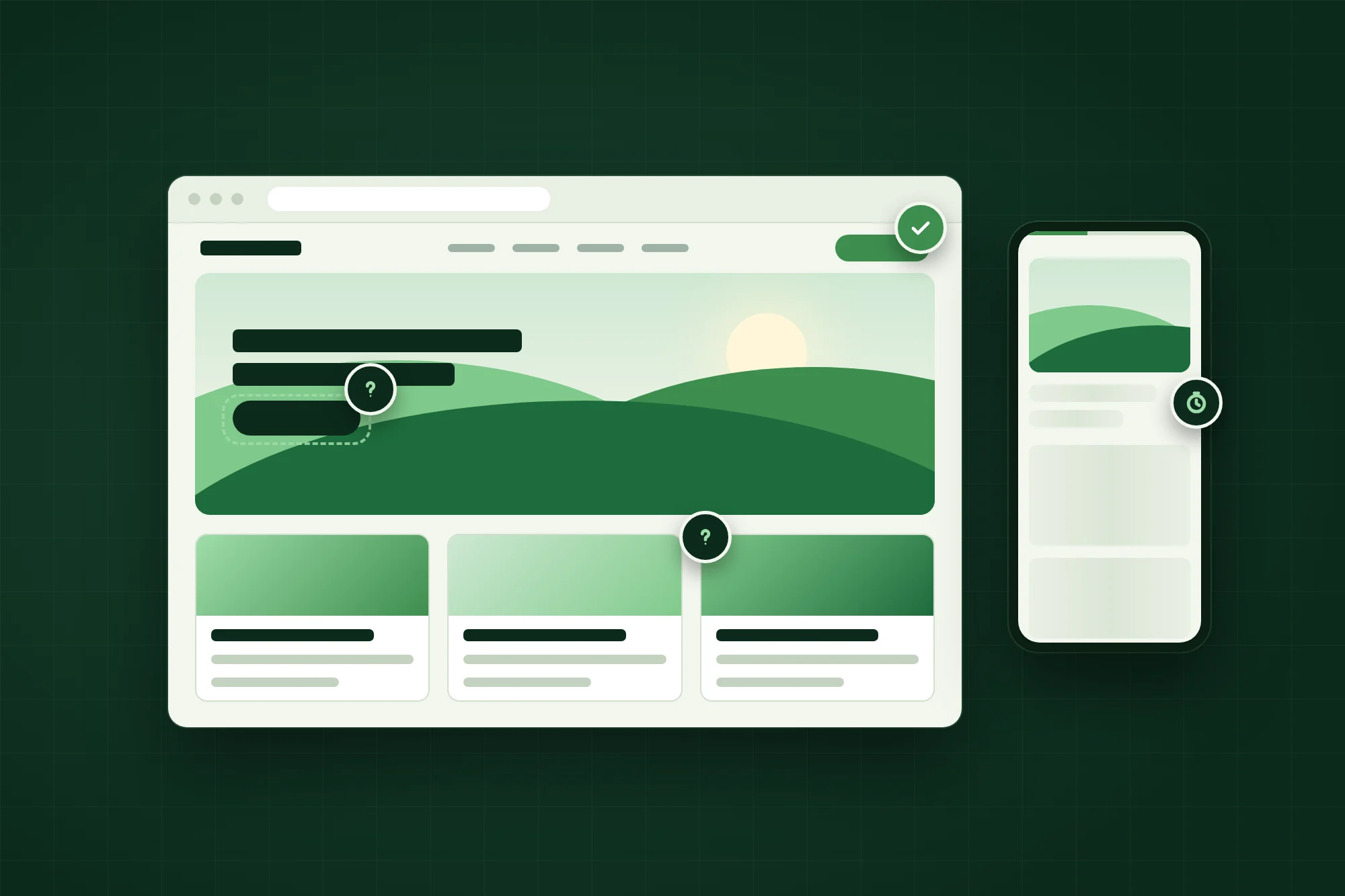
A site can look finished and still fail where it counts: poor UX, weak accessibility, slow mobile performance or broken integrations with a booking or payments system.
We put this to the test when we crawled 606 independent accommodation websites and found that 86% loaded in over 4 seconds on mobile. Google flags this as not great, and it's one of the biggest causes stopping your website from being a frictionless booking site.
When it comes to mobile speed, Milliseconds Make Millions found that just a small gain in load times increases conversion rates.
A site that looks finished on a desktop can still be losing bookings on a mobile phone. At Booked Wild, we make sure every website we build is mobile-ready so that it loads on even the weakest of signals.
This is something a solely AI website cannot perfect.
What Goes Wrong Without a Human Check
Several things can go wrong if you don't have a human behind the scenes:
- There's no one to sense-check the information it has produced. Inaccurate information can cause real issues for you and your customers. AI is known for being unreliable in the facts it produces.
- Booking journeys are built around what looks logical to a model, not what a customer actually does
- Accessibility gaps create legal exposure and lock out real customers
- Integrations for payments, availability and enquiry forms pass a visual review but can fail in production or be more complicated than a customer expects
- No one is accountable for why a decision was made, so more problems surface after launch instead of before it
The fix isn't slower production. It's a review stage before launch — someone checking the booking journey, the integrations and whether the site actually works for a real guest, not just in a prototype.
Our Take On AI Websites
The point of this isn't that AI is taking jobs or replacing people, a misconception a lot of people still have. It's about AI as a production tool. It's about the fact that AI makes experienced designers faster, but it doesn't replace the judgement needed to create an effective website.
The value is in using AI to speed up production while spending the time saved on things that actually affect the customer experience and bookings: strategy, hierarchy, conversion and QA. That's how we work with every client.
See what AI creation looks like with a human behind it.
We combine AI-assisted production with the design, UX and booking-journey expertise your site needs to actually convert. Apply for a homepage redesign.
Got it. We'll be in touch.
One of us will read what you've written and come back with a straight answer — not a proposal template.
FAQs
Can I just launch what AI builds?
Not safely. A prototype can look complete while still failing on accessibility, mobile performance, integrations or the actual booking flow. It needs human review before it goes live.
What does human review actually catch that AI doesn't?
Whether the design fits real customer behaviour and the booking journey, whether the site performs on mobile, and whether every integration — payments, availability, enquiry forms — actually works end to end.
Does AI make a website launch faster?
Yes, at the production stage. Concepts, layouts and prototypes come together in days instead of months. Launch readiness still depends on the review and testing that happens after.
Who fixes it if something breaks on an AI-built site?
Someone technical needs to be behind the scenes. AI can generate a working-looking build, but troubleshooting errors and making judgment calls when something doesn't work as expected still needs a person.
Is a fully AI-built website ever ready to launch as-is?
Rarely. It can be close on the surface, but a human still needs to check the booking journey, accessibility, mobile performance and integrations before it goes live.