Direct Bookings
Breaking Third-Party Dependency: A Step-by-Step Guide to Reclaiming Your Margin
OTAs, marketplaces and reservation platforms can bring valuable bookings, but relying too heavily on them comes at a cost. Here's how independent travel and hospitality businesses can strengthen their direct channels, protect more of their margin and build a healthier distribution mix.
 Colin HarrisonFounder23 September 2026
Quick answer
Third-party booking platforms aren't the enemy. They offer reach, visibility and access to customers that independent businesses may struggle to attract alone.
The problem is dependency.
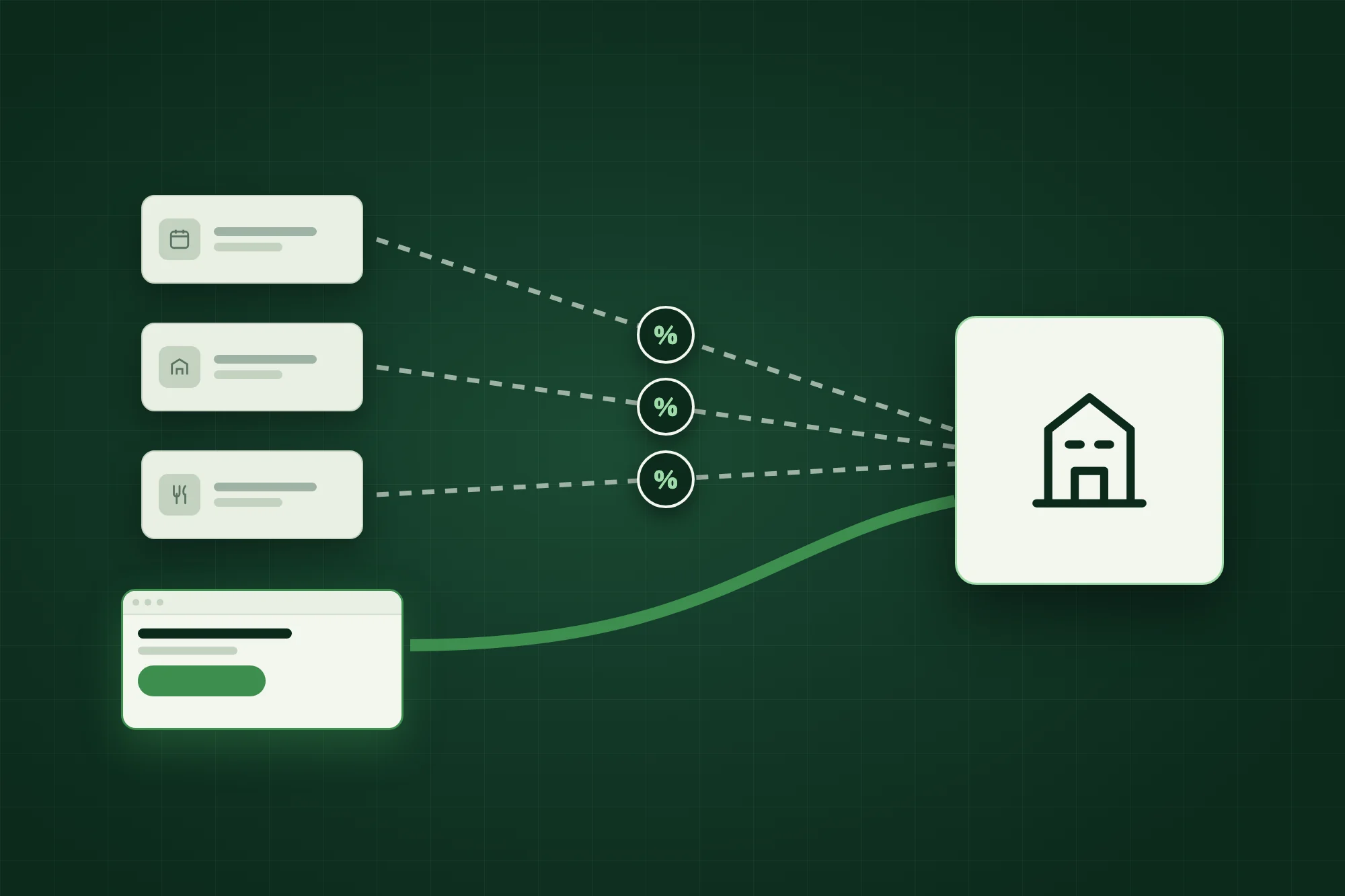
Whether you're paying OTA commission on accommodation bookings, marketplace fees on tours and experiences or reservation fees for restaurant covers, every third-party booking has an acquisition cost.
Reducing that dependency doesn't mean abandoning the platforms. It means improving your website and booking journey, giving customers a reason to book direct and investing in marketing channels you control. Over time, that can shift more bookings towards direct channels and help you keep more of the revenue you're already generating.
Third-party bookings aren't the problem. Dependency is.
Every booking has a cost.
For an independent hotel or holiday rental, that might be commission paid to an OTA. For a tour operator, it's the percentage handed to an experience marketplace. For a restaurant, it could be a fee attached to diners acquired through a reservation platform.
These platforms have earned their place in travel and hospitality. They can put independent businesses in front of huge audiences, simplify discovery and generate bookings you may never have won alone.
But there's a difference between using third parties as part of your distribution strategy and depending on them to run your business.
When too much of your revenue comes through somebody else's platform, you're not only handing over margin. You're relying on another business to connect you with your own customers.
The long-term answer isn't to ditch the OTAs, marketplaces or reservation platforms. It's to build a direct channel strong enough that you don't have to depend on them.
How much are third-party bookings costing you?
The platform changes depending on which corner of travel and hospitality you operate in. The principle doesn't.
Accommodation businesses contend with OTA commissions. Tour and experience operators pay marketplace commission. Restaurants may pay reservation or cover fees for diners acquired through third-party platforms, and those costs can be significant.
Arival reported in 2025 that some GetYourGuide operators had been notified of commission increases reaching or exceeding 30%. Its research also found that OTAs accounted for around 33% of tour and activity bookings globally in 2024.
The restaurant model is slightly different. OpenTable's UK pricing currently states that restaurants on its Core and Pro plans pay cover fees when diners are acquired through the OpenTable marketplace, while reservations made directly through the restaurant's website don't attract those cover fees.
The exact figures vary by platform, agreement and sector, which is why the most important percentage isn't an industry average — it's how much of your own revenue comes through third parties, and how much acquiring those bookings actually costs you. A £200 booking isn't necessarily worth £200 to your business: take away commission, discounts and other acquisition costs and the picture can look very different, and multiplied across hundreds or thousands of bookings a year, that turns from a marketing question into a margin question.
Direct bookings are still winning
It's easy to assume the major booking platforms have already won the distribution battle, but recent European hotel data suggests otherwise.
HOTREC's 2026 European Hotel Distribution Study analysed data from 2,713 hotels and found that 51.3% of bookings were still made directly with hotels, compared with 29.9% through OTAs — more than half of bookings were direct — as PhocusWire also reported.
There is an important caveat. OTA share has grown over the longer term, rising from 19.7% of European hotel bookings in 2013 to 29.9% in 2025 — so direct isn't disappearing, but the competition for those bookings has intensified — according to HOTREC's full study.
There could be more value in winning them, too. SiteMinder analysed more than 125 million hotel reservations for its 2025 Hotel Booking Trends report and found that hotel websites generated an average of US$519 per booking in 2024, compared with US$320 through OTAs.
That doesn't mean every direct booking is automatically more profitable. But it does show why your own booking channel deserves more attention than simply treating your website as an online brochure.
Why your website is a distribution channel
Imagine someone discovers your hotel on Booking.com, your walking tour on GetYourGuide or your restaurant through a reservation platform. They like what they see, then they Google your name — and that's your opportunity. But if they land on a slow website, can't find prices or availability, struggle to understand what's included or have to fight their way through a clunky booking system, going back to the third party suddenly feels much easier.
You're not asking customers to choose between “direct” and “OTA” in the abstract — you're asking them to choose between two booking experiences, and convenience is powerful. SiteMinder's Changing Traveller Report 2025 found that 52% of travellers had abandoned an online accommodation booking because of a poor digital experience.
Your website can look fantastic, rank well and tell your story beautifully, but if the booking journey doesn't work, you're leaving revenue on the table. Here's where to start.
How to reduce your third-party dependency: step by step
Step 1: Measure your third-party dependency
Step one starts with your numbers.
Look at the last 12 months and break your bookings down by source. Consider booking volume, revenue, commission and platform fees, discounts, advertising costs, cancellations, average booking value and repeat business.
Then calculate what each channel is actually costing you. You may discover that an apparently expensive channel is generating valuable incremental demand.
You might also discover you're repeatedly paying a third party to acquire customers who already know your business. That distinction matters.
Third-party commission can make commercial sense when a platform introduces you to someone you couldn't efficiently reach yourself. But it makes much less sense when a previous customer searches for you again and still finds it easier to book elsewhere.
The goal isn't zero commission. It's paying commission only when the distribution is genuinely earning it.
Step 2: Fix your direct booking journey
Before spending more on SEO, content, paid advertising or social media, make sure the traffic you're already attracting has somewhere effective to go.
Ask yourself the following questions:
- Can someone immediately understand what you offer?
- Can they find availability?
- Is there an obvious booking CTA?
- Does everything work properly on mobile?
- Are prices and inclusions clear?
- Do you provide enough reviews, credentials and trust signals?
- How many unnecessary steps sit between arriving and booking?
Every point of friction creates another opportunity for a potential customer to leave. That's why we don't see a travel or hospitality website as simply a piece of marketing. It's part of your booking infrastructure.
Step 3: Give customers a reason to book direct
From the customer's perspective, the third-party option may already be familiar, convenient and trustworthy. Your direct experience has to compete with that.
You don't necessarily need to slash your prices to make yourself more attractive, you just need to give your guests the best booking journey possible.
You could even give your customers some additional benefits for booking direct. This could include flexible cancellation, better availability, complimentary extras, priority check-in, flexible tour times, welcome drinks, dining perks, exclusive packages or rewards for returning customers.
Your flexibility as an independent business is your advantage. A huge platform has to create a booking experience that works for thousands of businesses. You only need to create one that works brilliantly for your customers.
Step 4: Build demand you own
Improving your website helps capture more of the demand that already exists. So now you need to create more of it.
SEO and useful destination content can introduce your business while people are researching a trip. Local partnerships and digital PR can put your name in front of relevant audiences. Email marketing gives you a way to stay connected with previous customers, where appropriate, without paying to reacquire them through a marketplace.
However, discovery itself is changing. Travellers aren't only using traditional search engines and OTAs anymore. They're increasingly using AI tools to research where to stay, what to do and where to eat.
That means the battle for the direct booking can start long before someone opens an OTA. The more opportunities customers have to discover and recognise your brand independently, the less dependent you become on a single source of demand.
Step 5: Rebalance rather than remove third parties
Reducing third-party dependency doesn't mean switching everything off. OTAs and marketplaces can be exceptionally good at what they do. They offer enormous audiences, established consumer trust and marketing budgets most independent operators could never replicate.
HOTREC's latest research demonstrates just how concentrated that reach has become. Booking Holdings and Expedia Group together accounted for 85.4% of European OTA hotel bookings in its 2026 study.
Trying to outspend them isn't a sensible strategy. Using their reach while strengthening the channels you control is.
For an accommodation business, that might mean retaining OTA distribution while making your own website the obvious choice for guests who already know your name.
For an experience operator, it could mean keeping marketplace availability while investing in destination content that reaches travellers earlier in their research.
For a restaurant, it could mean using reservation marketplaces for discovery while making the website the easiest route for returning diners to reserve.
The right balance will be different for every business. And third-party platforms should be part of your distribution strategy, not the only one.
What could shifting 10% direct mean for your business?
You don't need to replace every third-party booking to make direct bookings worth investing in.
Consider a business generating £500,000 in annual bookings.
If 10% of that revenue — £50,000 — moved from a channel charging 20% commission to a genuinely lower-cost direct channel, that's up to £10,000 in gross commission avoided before accounting for the costs involved in generating and processing those direct bookings.
That's an important distinction. Direct bookings aren't free. Your website, booking technology, SEO, advertising, content, CRM and wider marketing all have costs attached. But they generate a large profit margin for you.
So, the aim isn't to replace one imaginary “expensive” channel with a supposedly free one. It's to build a more profitable and resilient distribution mix. And once you've built the infrastructure to generate direct demand, you're not only looking at the value of one booking. You're building an audience you can reach again.
Our Conclusion
Third-party platforms aren't going anywhere. And we don't believe they should. Instead they should be used as part of the overall acquisition channel.
They can introduce independent travel and hospitality businesses to huge audiences and deliver valuable incremental bookings. But when they become the only reliable route between your business and its customers that's where things become harder.
By understanding your current distribution mix, improving the booking experience you own, and giving people a genuine reason to choose you, you'll start to tip the balance in your favour.
You don't need to ditch OTAs, marketplaces or reservation platforms to take back more control.
You need a direct channel that works harder.
At BookedWild, we help independent travel and hospitality businesses turn their websites into effective booking channels, supported by marketing designed to get them found and give more customers a reason to book direct.
From your website and booking journey to SEO, content and wider digital strategy, we'll help you build a stronger route between discovery and booking — without relying on a third party at every step.
Ready to shift the balance towards direct? Talk to BookedWild about your website and marketing.
Got it. We'll be in touch.
One of us will read what you've written and come back with a straight answer — not a proposal template.
FAQs
What is a direct booking?
A direct booking is made with a travel or hospitality business without completing the transaction through a third-party marketplace or OTA. This could be through your own website, booking engine or another channel you directly control.
How can I increase direct bookings?
Start by making your direct booking journey as easy as possible. Clear calls to action, transparent pricing, mobile-friendly design, fast page speeds and a simple booking process all matter. From there, invest in channels that help customers discover you directly, including SEO, useful content, email marketing, digital PR and AI search visibility. Giving customers genuine benefits for booking direct can also help make your channel more attractive.
Should I stop using OTAs and third-party booking platforms?
Not necessarily. OTAs and marketplaces can provide valuable reach and introduce your business to customers who may not otherwise discover you. The aim is to avoid becoming overly dependent on them. A balanced distribution strategy lets third parties generate incremental demand while your website and marketing capture more direct bookings.
Are direct bookings always cheaper than third-party bookings?
No. Direct doesn't mean free. Your website, booking technology, payment processing, SEO, advertising and other marketing activity all have associated costs. The important metric is your cost of acquisition by channel. Understanding those costs alongside booking value, repeat business and customer lifetime value gives you a much clearer picture of which channels are actually working hardest for your business.
Why is a website important for direct bookings?
Your website is one of the few parts of the booking journey you control. It gives potential customers somewhere to research your business, understand your offer, check availability and book without returning to a marketplace. Done well, it isn't simply an online brochure — it's a sales and distribution channel in its own right.