Direct Bookings & SEO
Stop Bidding Against Yourself: Why Third-Party Platforms Outrank You
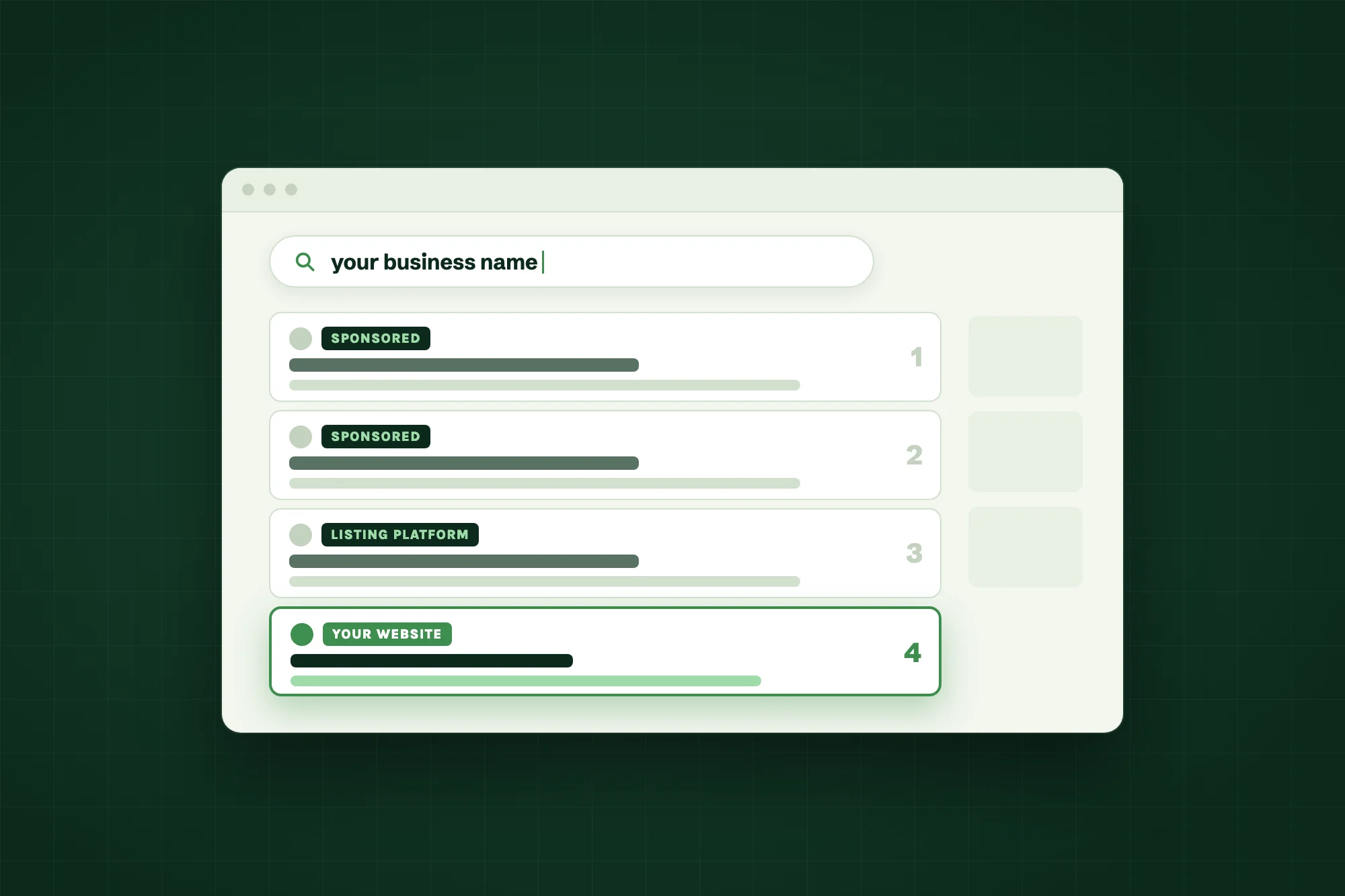
Type your business name into Google and the platform taking a cut of your bookings is often the one that shows up first. Sometimes because it paid for that position, sometimes because it simply built more authority than your site ever had.
 Colin HarrisonFounder18 September 2026
Quick answer
Third-party platforms and OTAs outrank your website on your own branded search more often than most operators realise, and it’s not always for the same reason.
Hotels and tour operators mostly lose it to paid bidding. Platforms like Booking.com, Viator, and GetYourGuide bid directly on your business's name in Google Ads, meaning a paid listing can sit above the organic result regardless of how well your site ranks.
For glamping sites, short-term rentals, and food and drink venues, it’s usually an organic battle. Heavyweights like Pitchup, Campsites.co.uk, Airbnb, OpenTable, and TheFork pack way more domain authority than your typical business website—meaning they’ll naturally grab the top spot for your brand name unless you actively bridge that authority gap.
Either way, the fix starts in the same place: treat your brand name as a keyword you have to actively defend, not one you already own.
Why OTAs outrank your website, whatever sector you're in
A business's own name isn't reserved space. No rule of trademark law or platform etiquette stops a competitor, an OTA, or a listings site from ranking above it — Google doesn't treat a name search as spoken for, and neither does a platform whose business model depends on intercepting exactly that moment. What follows breaks down how that plays out sector by sector, because the mechanism isn't identical everywhere.
Hotels: OTAs bid on the name you already built
Hotels have the clearest paper trail on this problem, because the cost of defending a branded search is now directly measurable.
SHR's 2025 study of 27 million CPC impressions across 100 hotels found that hotels that let an OTA undercut their own rate pay 47% more per click on their own branded search terms.
That's the mechanism behind bidding against yourself in its purest form: OTAs deliberately raise their bid on a specific hotel's name once they know they can beat that hotel's own price, so the hotel ends up paying more just to compete for traffic on its own brand.
Metasearch platforms — Google Hotel Ads, Tripadvisor, Kayak — sit in the same lane. A traveller searching for a hotel by name sees the hotel's own rate listed alongside OTA rates on the same results page, competing for the same click. Without an active metasearch campaign, the hotel's listing simply doesn't appear there at all, leaving the OTA rate as the only option in front of the traveller.
Short-term rentals: Airbnb, Vrbo, and Booking.com own the discovery layer
For self-catering and short-term rentals, the competition isn't paid search — it's organic authority. Airbnb, Vrbo, and Booking.com hold domain authority in the low-to-mid 90s and routinely take the top organic positions for broad location terms because they're serving a different search intent: someone comparing dozens of options, which a single property page can't do. That's expected and not the real problem.
The real problem is when that same platform dominance bleeds into branded search — a guest who already knows the property's name still lands on an Airbnb or Booking.com listing page before they reach the operator's own site. The platforms' domain authority and constant content output mean they frequently rank for terms an operator would assume were theirs by default, including their own trading name paired with location.
Glamping and Camping: Pitchup and Campsites.co.uk own the discovery layer
Glamping sites face the same organic-authority gap, just against a different pair of platforms. Pitchup alone carries an Ahrefs Domain Rating of 77, lists more than 6,000 sites, and takes a 15% commission on every booking it sends an operator's way. Campsites.co.uk competes for the same ground. Either platform holds the top organic positions for broad discovery terms for the same reason Airbnb does for self-catering rentals — the search intent is comparison, not a specific site.
This is a discovery problem for glamping specifically: most glamping guests haven't decided on a specific site yet when they start searching, so losing the generic discovery terms to Pitchup or Campsites.co.uk is somewhat expected. What's avoidable is losing the branded search — the guest who already found the listing on the platform and is now checking the operator's own site to see if booking direct is cheaper or easier.
Tour operators: Viator and GetYourGuide intercept at the last click
Tour operators face the cleanest version of this problem, because it's transactional rather than about content or domain authority.
OTAs run Google Ads directly against a tour operator's company name. When someone searches for the operator by name, a Viator or GetYourGuide ad can appear above the operator's own organic listing. The customer was already looking for that specific operator — not comparing options — and still gets routed through the OTA, which then takes its standard 20–30% commission on a booking that would have converted directly anyway.
This isn't a shrinking problem. Arival's State of Experiences report found OTA share of tour and activity bookings climbed to 37% in 2025, up from 33% in 2024 and 28% in 2023, while bookings through operators' own websites fell from 29% to 25% in that same year. The direction of travel keeps handing more of this fight to the platforms, not less.
Google Reviews compound the same problem from a different angle. Adventure and activity operators who rely heavily on OTA bookings accumulate most of their reviews on Viator, GetYourGuide, and Tripadvisor rather than their own Google Business Profile, according to Basecamp Advertising. A thin Google Business Profile means weaker local search rankings, which means less organic direct traffic, which pushes more bookings back through the OTAs — a cycle that reinforces itself.
Food and drink venues: reservation platforms outbuild your SEO
Restaurants and venues face the same organic-authority gap as glamping and STR, just with review and reservation platforms instead of booking platforms. Yelp alone carries an Ahrefs Domain Rating of 95, and SEO advisors who work with restaurant clients confirm this plays out specifically on the restaurant's own name, not just category searches: Yelp's pages are built to rank for local business names, and its domain authority wins that fight by default even against an otherwise well-optimised restaurant site, according to Five Blocks.
TheFork and OpenTable follow the same pattern on the booking side, with TheFork alone processing bookings for over 55,000 restaurants and pulling significant organic search visibility along with that scale. A venue's own site is one page competing for a name search; the platform is a domain with tens of thousands of listings, constant content updates, and years of accumulated authority behind it.
The commercial cost shows up in the small print. Reservations that arrive through a venue's own website, Google, or social channels are typically free. Reservations routed through the platform can carry a per-cover or commission fee — meaning a diner who already knew the restaurant's name, searched for it, and landed on the platform's page instead of the venue's own site converts into a paid booking for the venue rather than a free one.
What this actually costs you
The mechanism differs by sector, but the price of losing a name search doesn't have to be estimated — it's already been measured or priced by the platforms themselves.
| Sector | How you lose it | What it costs you |
|---|---|---|
| Hotels | Paid bidding — an OTA bids up your own branded CPC | 47% higher cost per click when an OTA undercuts your rate (SHR, 2025) |
| Tour operators | Paid bidding — an OTA bids directly on your business name | 20–30% commission on a booking that would have converted direct (Basecamp Advertising) |
| Glamping & short-term rentals | Organic — platform domain authority beats an unbuilt site by default | Roughly 15% of booking value in platform fees on a stay that should have booked direct (Lodgify) |
| Food & drink | Organic — platform domain authority wins the name search | A per-cover or commission fee on a booking your own site should have taken for free |
Whichever row applies, the number isn't a rounding error. It's the ongoing cost of never having contested the search in the first place.
What actually closes the gap
The fix isn't one thing — it splits the same way your problem does.
If you're losing to paid bidding — hotels, tour operators:
- Run a branded PPC campaign so your own listing sits in the auction instead of ceding it by default
- If you run a hotel, keep an active Google Hotel Ads or metasearch presence
- You don't need to outspend the platform — an unopposed bid is already the cheapest one in the auction
If you're losing to organic authority — glamping, short-term rentals, food and drink:
- Consolidate your reviews on Google Business Profile rather than leaving them scattered across platforms
- Build backlinks from local press, tourist boards, and directories
- Publish content that answers the specific searches a generic platform listing can't
Either way, the fix is never about beating an OTA or third-party platform at scale. It's about contesting one keyword: your own name.
Our Conclusion
Branded search is the easiest visibility to defend and the easiest to give away by assuming it's already won.
Across hotels, short-term rentals, glamping, tour operators, and food and drink venues, the same three gaps show up:
- No active bid strategy on the business's own name
- A website that can't out-authority the platform on branded terms
- No metasearch or reviews strategy pulling weight back toward the operator's own domain.
None of that requires beating an OTA or any other third-party platform on its own territory. It requires treating a name search as a keyword worth defending, the same as any other.
Winning that search back is only half the job — once a guest lands on your own site instead of the platform's, a frictionless booking journey is what turns the click into a booking.
Ready to see where you're losing your own name search?
BookedWild helps travel and hospitality businesses improve their website visibility. Contact us today to see how we can help you win back the search results for your own name.
Got it. We'll be in touch.
One of us will read what you've written and come back with a straight answer — not a proposal template.
FAQs
Why do OTAs outrank my website for my own business name?
Two mechanisms, depending on the sector. In hotels and tours, OTAs bid directly on your business name in Google Ads, so a paid OTA listing can sit above your organic result regardless of how well your site ranks. In glamping, STR, and food and drink, it's usually organic: the platform's domain has far more authority than a typical operator site, so it wins the name search by default unless the operator has actively built up their own site's authority.
Can I stop OTAs from bidding on my brand name in Google Ads?
No platform can be blocked from bidding on a business name unless that name is a registered trademark and a formal complaint is filed with Google — and even then, enforcement is inconsistent. The practical fix is running your own branded search and metasearch campaigns so your listing appears above or alongside theirs, rather than relying on organic ranking alone.
Is losing branded search to Airbnb or Booking.com always a bad thing?
Not entirely. Some of that traffic is genuine discovery — a guest who hasn't chosen a property yet. The problem is specifically when a guest who already knows the property name still lands on the OTA first, because that's a booking the operator's own site should have captured directly.
Does this apply to small, single-property operators or only larger groups?
It applies more to small operators, not less. Larger groups usually have some paid search budget defending their name by default. Independent operators are the ones most likely to have never run a branded campaign at all, which is exactly the gap OTAs and aggregators are built to fill.
Where should an operator start if they've never run branded search protection before?
Start by searching the business's own name in an incognito browser and noting what outranks the website — paid ads, metasearch listings, and organic results. That single search usually reveals which platform is the biggest offender, and from there the fix is either a metasearch listing, a small branded PPC campaign, or both.