Direct Bookings
Owning Your Audience: Why Social Media Should Always Lead Back to Your Website
Organic reach on Instagram and Facebook keeps shrinking, TikTok decides who sees you one post at a time, and a follower count was never a list you could rely on. Here's where social media fits in digital marketing for travel, and why every post should lead back to your website.
 Colin HarrisonFounder25 September 2026
Quick answer
Social media is a valuable part of digital marketing for travel businesses. It's where plenty of guests first notice an independent travel or hospitality business, and good content builds recognition you'd struggle to buy.
The risk comes when it's the only place your audience exists.
Your followers sit on the platform, not with you. Average organic reach is now around 3% of followers on Instagram and just over 1% on Facebook, and accounts can be restricted or removed with little warning.
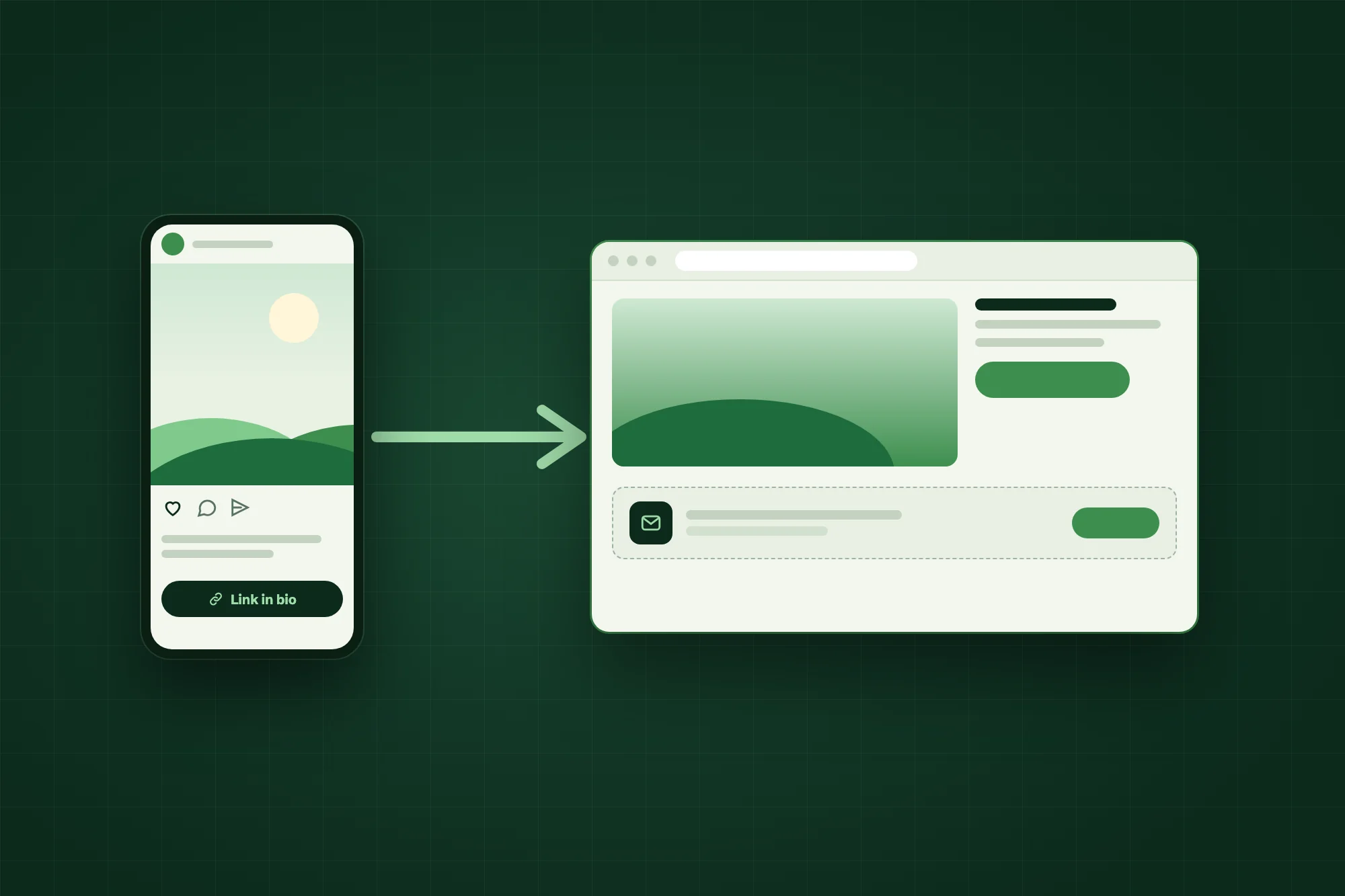
Fixing that doesn't mean posting less. It means making sure every post leads back to your website, where people can explore, enquire, join your mailing list or book. Over time, that turns borrowed attention into an audience you can reach again.
Social media is a great place to be found. It's a risky place to keep your audience.
Every post has a limit on who sees it, and unfortunately you don't set it.
Instagram, Facebook and TikTok decide it for you, and they can change that decision overnight without explanation. It doesn't matter how long you've spent building the following.
These platforms have earned their place in digital marketing for travel. They're free to use, they put your business in front of people who may never have found it, and they let a small operator look every bit as good as a big one.
But there's a difference between using social media to find guests and depending on it to keep them.
Earlier this week, in our guide to breaking third-party dependency, we looked at what happens when too many bookings run through somebody else's platform. Social media is the same problem one step earlier. When your audience only exists inside another company's app, you're relying on that company to decide whether your own customers see or hear from you.
Most of your followers won't see your next post
A glamping site with 4,000 Instagram followers posts a sunset shot of its new bell tent. It's a good photo, posted at the right time, with a caption someone spent twenty minutes getting right. And yet, only 130 of those 4,000 people will see it.
That figure comes from Socialinsider's analysis of over 870,000 brand posts between January 2025 and August 2026. By August 2026, the average Instagram post reached just 3.2% of an account's followers, down 14% from the year before. Facebook sat at just 1.25%. Put the same 4,000 followers on a Facebook page, and that means roughly 50 people see the post.
TikTok works differently, and it's easy to assume it solves the problem. Its ‘For You’ feed shows posts to people who don't follow you, which is brilliant for discovery. But that means an algorithm decides your audience post by post, and your followers matter even less. Socialinsider's 2026 benchmarks show TikTok engagement by followers falling 10% year on year, to an average of 2.6%.
Whichever platform you use, the post is never the finish line. Its job is to earn attention and send the people who care most to your website, where you can keep them.
Nothing about the business changed. Your account didn't do anything wrong. It's just that the platforms are working exactly as they're designed to. As Phil Treagus-Evans of Giraffe Social puts it in PhocusWire, Meta and TikTok now sell reach back to businesses as an advertising product. The organic post is the free sample. The boosted post is the thing they actually sell.
3.20% is the average share of an account's Instagram followers who see a brand post. On Facebook it's 1.25%.(Socialinsider, August 2026)
A follower count isn't a guest list
In the summer of 2025, tens of thousands of people reported that Meta had suspended their Instagram and Facebook accounts in error. A petition asking Meta to fix it passed 25,500 signatures. More than 500 people contacted the BBC; many described their business as being thrown into chaos overnight. Meta publicly acknowledged a technical error affecting Facebook Groups, but little beyond that.
Not every business will be caught up in something like that. The point is that they could be, and there would be nothing to fall back on. Years of followers, every enquiry that came in by DM, every past guest who tagged you in a photo- none of it comes with you. You can't email a follower. You can't message them next February when summer dates open. You can post, and then the platform decides who sees it.
That's the real difference between an audience and a following. An audience is people you can reach when you choose to. A following is people a platform lets you reach when it chooses to. Your website is where one turns into the other. Every visitor who enquires, books or joins your mailing list is someone you can reach again.
UK travellers aren't scrolling their way to a booking
The popular story is that travel is now decided on social media. The data for UK travellers says otherwise. In Booking.com's 2026 Travel Trends survey, 23% of UK travellers said they use social media for travel inspiration, the lowest of any market in the study. In China it was 68%, in India 63%, and in the US and Germany 34%. Simon-Kucher's 2026 Travel Trends study found a similar pattern across the continent, with more than half of Europeans saying social media doesn't influence where they go.
This doesn't make social pointless. The same Simon-Kucher study found that more than half of younger travellers are still influenced by it, and for many businesses it's where a guest first sees their place, experience, food, or drink. But it does mean most people booking a UK cabin, B&B, or guided tour aren't making the decision inside an app. Social is one touchpoint among several. The decision still happens on a website, and the only question is whose.
23% is the share of UK travellers who use social media for travel inspiration, the lowest of any market surveyed.(Booking.com 2026 Travel Trends)
Your website is the hub of digital marketing for travel
Our view is simple. Social media is one part of your digital marketing, not the whole of it. Use it to build attention, but don't let it become the only place your audience exists.
For an independent hotel, holiday property or tour operator, the website should be the central point every post leads back to. It's where a visitor can explore the place properly, enquire, join a mailing list or book, and each of those leaves you with a relationship no platform can switch off.
Treagus-Evans makes the same case from the social side. Every piece of content should do two jobs: earn attention where the algorithm can see it, and move the most interested people somewhere the business controls.
The second job is where most independent businesses fall down, and our own data shows why. When we crawled 606 independent accommodation websites, 86% took more than four seconds to load on mobile. The average was 13.3 seconds. Just 1% loaded in under two seconds.
Social traffic is almost entirely mobile traffic. Someone taps the link in your bio, waits, and goes back to scrolling. The post did its job. The website didn't.
Fixing that isn't complicated. Link to the specific cabin, tour or offer the post is about, not the homepage. Make sure availability and the enquiry or booking button are visible without hunting. Give people who aren't ready to book a reason to leave an email address. We've written more about removing the friction in our guide to frictionless booking websites.
An email address is worth more than a follower
The DMA's Marketer Email Tracker 2026 puts the average return on email marketing at around £41 for every £1 spent. In hospitality specifically, research from Sojern found that 81% of hotel executives saw revenue rise after putting a first-party data strategy in place, meaning they built up and used their own guest data rather than relying on someone else's.
The reason is ownership. An email list goes where you send it. Nobody reduces its reach because your content type fell out of favour this month, and it doesn't vanish if a platform locks your account. Every guest who stays and opts in is someone you can invite back next year, without paying anyone for the introduction.
Most independent businesses already have more chances to collect addresses than they use:
- A clear opt-in on the booking confirmation and enquiry form
- A waitlist for peak dates or next season's openings
- A short local guide, walking route or packing list guests genuinely want
- A post-stay email that lands just ahead of the same week next year
Every one of these lives on your website or booking journey. That's why social media needs a website to send people to. Without one, the attention has nowhere to become a relationship.
Keep it consented and keep it useful. A list of people who asked to hear from you will outperform a bigger one that didn't.
What this looks like for an independent operator
The platform changes depending on which corner of travel and hospitality you work in. The principle doesn't.
For a glamping or cabin site, social is often how guests first discover you. Link each post to the unit it shows, with live availability, and offer a waitlist for the dates that always sell out.
For a short-term rental host, listing platforms make every property look interchangeable. Social and your own website are where you become the specific place a guest remembers, and a past-guest email list is what turns a one-off stay into a direct repeat booking.
For a tour or experience operator, short video is where your guides, routes and personality do the selling. Send viewers to a tour page that takes the booking directly, then follow up after the trip with photos and an invitation to come back or bring a friend.
For a pub or restaurant, Instagram and Facebook are often the shop window. Make your website the easiest place to book a table, and use email to tell regulars about new menus and events before you post them anywhere else.
The right balance will be different for every business. Social media should be part of how people find you, not the only place they can.
Our conclusion
Social media isn't going anywhere, and it deserves its place in digital marketing for travel. It's where plenty of guests first notice you, and good content builds recognition that pays off later.
But when a follower count becomes the main measure of your audience, things get fragile. Algorithms will keep changing. Reach will keep being sold back to you. The businesses that shrug off the next change will be the ones that spent this year making sure their social activity leads somewhere they own, and that the website at the end of that link is fast enough and clear enough to do its job.
You don't need to post less to own your audience. You need a website worth sending it to.
FAQs
Where does social media fit in digital marketing for travel?
Social media is one channel within a wider digital marketing mix. It's strongest at discovery and inspiration. Your website, search visibility and email list do the work of turning that attention into enquiries, bookings and repeat guests.
Should independent travel businesses stop posting on social media?
No. Social media is still a strong discovery channel, particularly for younger travellers. The aim is to stop relying on it as the only place your audience exists, and to use it to send people to your website and email list.
Why is organic reach on Instagram and Facebook falling?
Platforms earn money by selling reach through advertising, so organic posts reach a small share of followers by design. Socialinsider's August 2026 data puts average reach at 3.20% of followers on Instagram and 1.25% on Facebook.
What counts as a channel a travel business owns?
Your website, your direct booking or enquiry system, and your email list. You control how they look, who you can contact and when, and they don't depend on another company's algorithm or account rules.
What's the easiest way to start building an email list?
Add a clear, consented opt-in to your booking confirmation and enquiry form. Then give people a reason to join before they book, such as a waitlist for popular dates or a useful local guide.
Where should social media posts link to?
The specific page the post is about, such as the cabin, tour or offer, rather than your homepage. That page should load quickly on mobile and make booking or enquiring obvious.
Make your website the place your social media leads.
At BookedWild, we help independent travel and hospitality businesses turn their websites into the place their marketing leads back to: fast, clear and built to capture enquiries, email sign-ups and direct bookings. From your website and booking journey to SEO, content and email, we'll help you build an audience that doesn't disappear when an algorithm changes.
Apply for a homepage redesignBook a free strategy call
Got it. We'll be in touch.
One of us will read what you've written and come back with a straight answer — not a proposal template.