Direct bookings / Website strategy
Holiday Let Website Design: Why the Build Starts Now
Next year’s holidays get planned over Christmas and booked between Boxing Day and New Year. For independent accommodation, camping and glamping operators, a new website that launches in January has missed the biggest booking window of the season.
 Colin HarrisonFounder1 October 2026
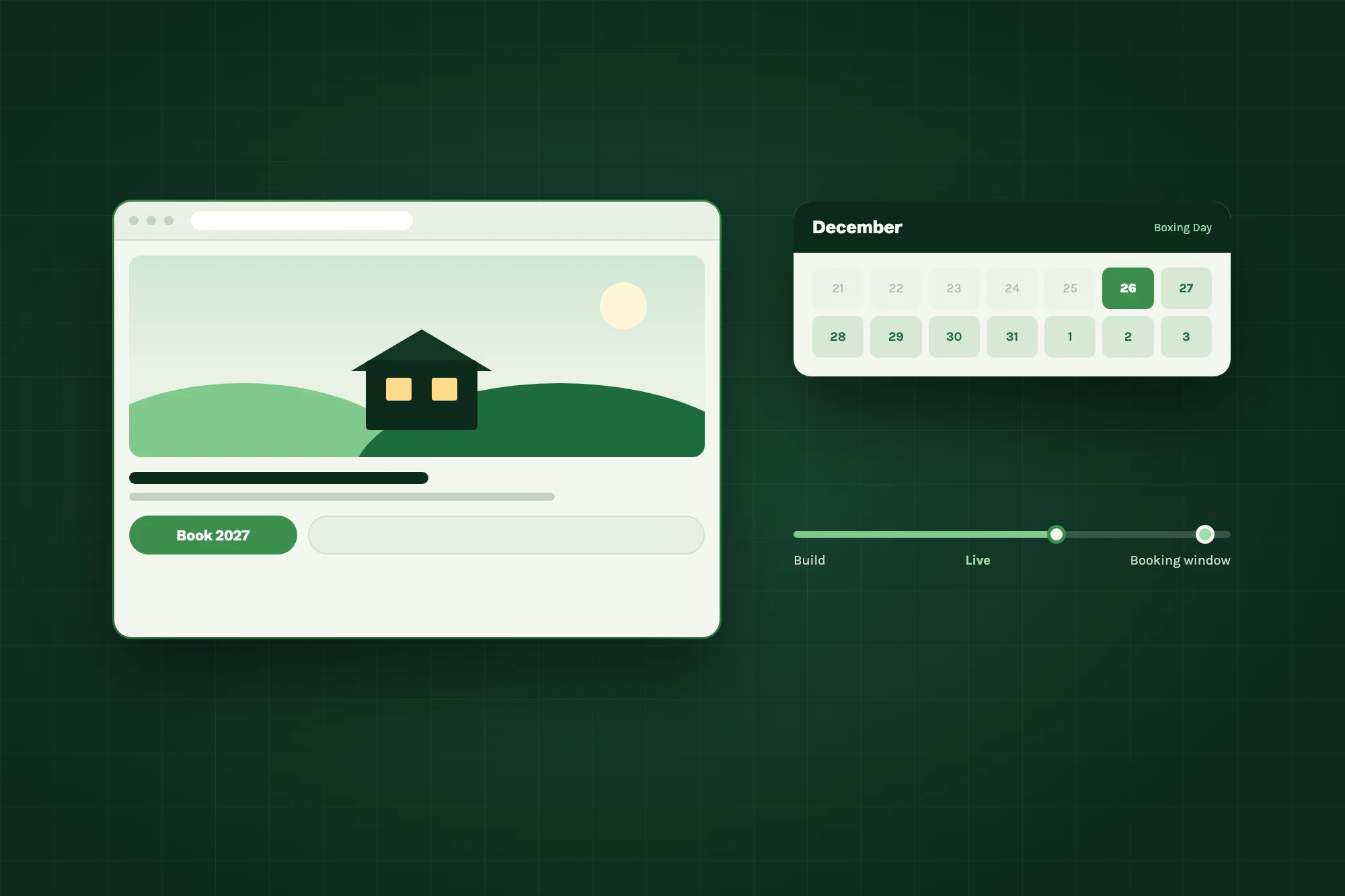
Quick answer
If you’re planning to relaunch or rebrand your holiday let, lodge, glamping or camping website for 2027, the new site should be live by early December. Next year’s holidays are booked from Boxing Day, and a relaunched site needs the weeks before that to settle in search, load next year’s availability, start tracking and have its faults fixed. A rebuild of an existing site can still launch before Christmas if it starts now. New businesses should aim for the same deadline, but a site built from scratch takes longer, so the start date matters even more.
Next year’s holidays are chosen over Christmas
Think about where next year’s holiday plans actually get made. It’s usually around the Christmas table, with the whole family in one room and the calendars out. By Boxing Day, someone is on their phone looking at accommodation.
The numbers back this up. Hoseasons reported that March bookings made between Boxing Day and New Year’s Eve 2021 were up 57% on the same week in 2019. Its chief commercial officer said Christmas and New Year are always strong booking periods for the brand, and linked the demand to people spending the holidays with family. Its TV campaign that year started on Boxing Day 2021 and ran until mid-January 2022.
A year later, it happened again. Hoseasons and cottages.com saw Boxing Day bookings 10% above their previous best, then put £1 million behind their January sale across TV, social, Spotify and email.
57% rise in March bookings made between Boxing Day and New Year’s Eve(Hoseasons, compared with 2019)
Most independent operators don’t have £1 million for a January campaign, and that’s fine. The money isn’t the lesson here. What the big brands are really showing you is when guests are looking and booking. You can’t outspend them, but you can be ready at the same time. If your website is live, indexed and working before Boxing Day, your lodge, cabin or glamping site is in front of those same guests, right alongside the bigger brands, without the big ad budget.
A new site needs time to settle
Google’s guidance on site moves says a small to medium-sized website can take a few weeks for most pages to move to new URLs. It also warns that rankings can fluctuate while Google recrawls and reindexes the site, and that they settle over time.
A complete rebuild changes URLs, page structure and internal links. Redirects carry the old pages’ authority across, but Google still has to visit every old and new URL before the move is complete. Launching in early December means that the settling period happens before the busiest weeks of the year, not during them.
Next year’s dates have to be bookable
A guest browsing on Boxing Day is looking at next year. If the calendar only shows this season, or next year’s prices aren’t loaded, that guest can’t book, however good the site might be.
A site launched in December goes live with next year’s availability, rates and booking rules already connected and tested. A site launched in January is still being populated while guests are choosing where to stay. This is also the case for simply updating your website. The downtime you experience out of peak season is the perfect time to start updating your website ready for next year.
Tracking has to be running before the traffic arrives
The turn-of-year window is the most useful data an operator gets all year. It shows which pages guests land on, where they drop out of the booking flow, and which channels send bookings.
A site launched in December records the whole window in one place. A site launched in January splits it across two websites, and the old site’s data stops just as the peak begins.
Problems are cheaper to fix before guests arrive
Guests don’t wait while a site is fixed. Boxing Day browsing happens on phones, on sofas, between films and leftovers. A new site has to load quickly on mobile and take a booking on a small screen at the first attempt. That gets tested on the live site before the traffic arrives, not during the busiest week of the year, and it is where most independent sites fall short on mobile.
While a new site is being indexed and fixed, the Boxing Day browsers are still booking. They find the big brands and the OTA listings, because those are the pages already ranking. An operator who launches in January arrives after the decision has been made.
Have your website live within 12 weeks
Twelve weeks is the longest timeline we set, and it covers a complete rebuild with migration and full testing before launch. Most sites go live well inside that. Build time depends on the size of the site, how quickly decisions and content come back, whether an existing site has to be migrated, and how much testing it needs.
| Project | What we did | Timeline |
|---|---|---|
| Independent holiday letting agent (in progress) | Complete rebuild and migration | 12 weeks, 8 September to w/c 1 December |
| Village pub | Website redesign | 5 weeks, 7 August to 11 September |
| Homepage redesign | Single-page redesign | Days, once the content is ready |
Our letting agent client first planned to launch in the new year, when most operators assume the booking season begins. Agreeing to that date would have been the easy answer. We knew it would put the launch in the middle of the busiest booking weeks, so we recommended a December launch and built the timeline back from Boxing Day. That advice comes from knowing when guests book, not only how websites are built.
The site goes live with around three and a half weeks for Google to process the move and for us to check every page, form and booking path. A site that looks finished isn’t finished until that testing is done.
What to have ready before the build
The more of this is in place on day one, the sooner a site can launch:
- Copy and property details for every page
- High-resolution photography you have the rights to use
- Logins for your current website, domain, hosting, booking system and any CRM or channel manager
- Next year’s rates, availability and booking rules
- One person who can sign off decisions
- Logos, colour schemes, and a direction you want the new site to take.
What we take care of
A rebuild doesn’t have to be something you manage alone. We specialise in travel and hospitality, and our founder has nearly 30 years’ experience in hospitality and marketing. We have handled the same problems on site after site, so we know where builds go wrong and how to fix them.
- Rankings protected through the move: every old URL is mapped and redirected, and search performance is monitored before and after launch.
- Your systems stay connected: your booking system, CRM, channel manager and payments carry across to the new site.
- Technical issues fixed quickly: we’ve seen them before, so you don’t lose hours researching them yourself.
- Tested before guests see it: every page, form and booking path is checked on real devices before launch.
- Ready for the window: next year’s dates are bookable and tracking is live from day one.
If you’d rather hand the build to a team that does this every week, contact us now.
If your build starts now
This applies whether you’re refreshing a site that has stopped earning bookings, replacing one that no longer fits the business, or opening in 2027 with no website at all. There is still time to be ready for the window. Every week that passes before the build starts takes some of that time away.
The window doesn’t close on New Year’s Day. Hoseasons’ 2024 turn-of-year sale ran to 4 February, and that final day was its best day for online bookings in almost three years. The company said guests arrived having done their research and knowing what they wanted. That research happens in the weeks after Boxing Day, on the sites that are ready for it.
What can be ready by early December depends on the size of the job:
- A homepage redesign is the quickest way to see what a new site could look like. We’re currently taking on 10 operators for a free homepage redesign, then talking through a full rebuild with those who want one. There’s nothing to pay unless you go ahead with the full build.
- A smaller site, like the five-week pub redesign, can start in October and launch in November with weeks left to test.
- A rebuild of an existing site can still be live before Christmas, provided answers and content come back quickly. The earlier it starts, the more time there is to test and settle before Boxing Day.
- A new website built from scratch takes longer. Starting now brings the launch as close to the window as possible.
The build starts now because every week of delay moves the launch closer to the busiest weeks of the year. Starting in October leaves room to choose. Starting in December leaves none.
Our Conclusion
Your booking season doesn’t start in January. It starts during a Christmas dinner and turns into bookings from Boxing Day, and the largest self-catering brands already plan their campaigns around this.
While independent operators can’t match the ad budgets of big chains, they can match their timing. A website launched by early December has settled in search, has next year’s dates open, is recording every visit and has had its faults fixed. Every booking it takes in that window is a booking that doesn’t go through a third party.
How much can be ready depends on the size of the website, but the choice has to be made now. There’s still time to get your website ready and relaunched by December, but acting now is crucial.
Get your new website live before the booking window opens.
We build and redesign websites for independent holiday lets, lodges, cabins, glamping and camping sites, designed to win direct bookings from the day they go live.
Got it. We'll be in touch.
One of us will read what you've written and come back with a straight answer — not a proposal template.
FAQs
How long does it take to build a booking website?
It depends on the size of the site, how quickly content and decisions are ready, whether an existing site needs migrating, and how much testing is built in. Our current full rebuild and migration for an independent holiday letting agent runs 12 weeks, including time to test before launch. A recent village pub redesign took five weeks, and a single homepage redesign takes days once the content is ready.
When do people book UK holidays?
Christmas and New Year are among the strongest booking periods for UK self-catering. Hoseasons reported record Boxing Day bookings, and its turn-of-year sale ran into early February.
How long does Google take to index a new website?
Google says crawling can take anywhere from a few days to a few weeks. A new site needs that time built in before its busiest booking period.
Is it still worth launching a new website in January?
A January launch still catches part of the turn-of-year window. It misses the start of it, and the site spends its first weeks being indexed and tested while guests are already booking.
What needs testing before a new website launches?
Page speed on mobile, the full booking flow, and every form and payment step. Our guide to a frictionless booking website covers the booking journey in detail.